Custom software development in Ottawa.
Velogics is an Ottawa software company: web and mobile apps, internal tools, integrations, and AI automation - scoped around your real workflow and built to last. The same team that designs your site, going deeper.
Your idea, brought to light
What does custom software from Velogics cost?
It is scoped and quoted rather than listed, and two published numbers sit behind that. Our Terms set a minimum project size of $499, and hourly engagements are billed at $150 an hour. Anything above the floor gets one fixed price written into a specification after a free scoping call, so you see the whole figure before agreeing to it.
We do not publish a typical range, because software scope varies too much for one to mean anything.
If software is in the way, we build the fix.
We are a software company in Ottawa, and every project we have shipped was shipped for a business here. The work is remote by default, so distance is not what decides whether we can take one on. The problem picks the stack - not a template, and not a platform's limits.
A marketing website is a different job from an application, and the same team builds those too, as web developers in Ottawa.
Web & SaaS apps
Custom web apps and products built around how you actually work - not a template.
Mobile apps
iOS and Android apps that feel native and load fast.
AI automation
Automate the manual, repetitive work that eats your week.
Internal tools & dashboards
Replace the spreadsheet chaos with tools your team trusts.
Integrations & APIs
Connect the tools you already use - CRM, calendar, payments, and more.
Custom AI builds
Bespoke AI features wired into your product or operations.
Not our first product.
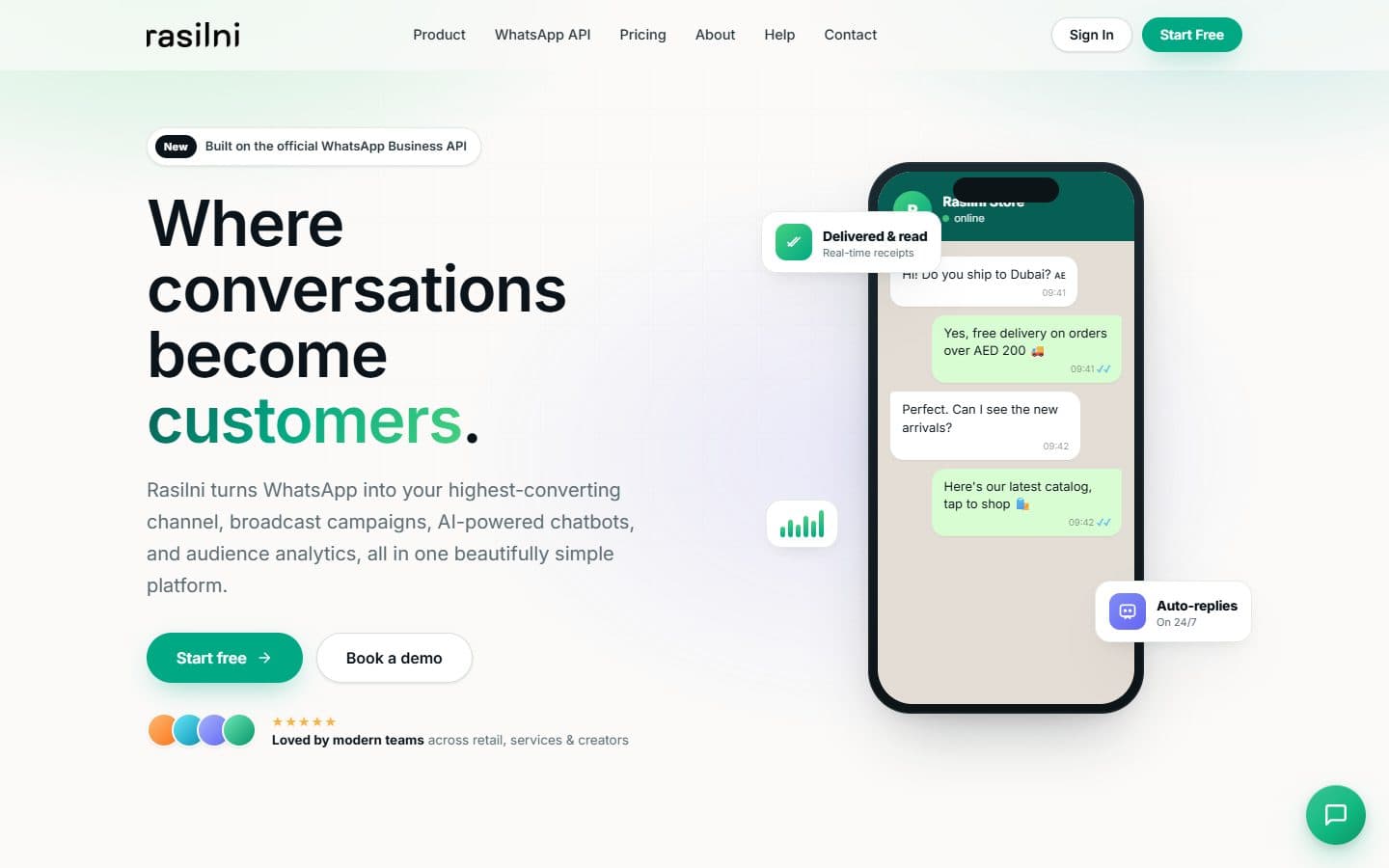
WhatsApp marketing SaaSRasilni is a full SaaS this team designed, built, and shipped - the product website and the web app behind it. The same stack, standards, and people your project gets.
- Product website + full web app
- Designed and hand-coded end to end
- Live and in use today
Why is there no price range on this page?
Because software scope varies too much for a range to mean anything, and a band wide enough to be true would be too wide to be useful. An internal tool that replaces one spreadsheet and a product with accounts, billing, permissions and a mobile app are not the same kind of thing, and putting them inside one number would flatter the first and mislead the second.
What you can anchor on is the floor and the rate. Our Terms set a minimum project size of $499, and hourly engagements, where an hourly arrangement is used instead of a fixed-price spec, are billed at $150 an hour. Anything larger than the floor gets one fixed number written into the specification after the free scoping call, so you see the whole figure before you commit to it.
If you want a comparison before you call, the website side of this business publishes everything: builds from $499 and plans at $59, $299 and $388 a month, all on the pricing page. The software line is quoted rather than listed because it is genuinely bespoke, not because the number is embarrassing.
What does a scoping call actually produce?
A written specification covering scope, a fixed price, a timeline and the deliverables. It is free, it does not oblige you to anything, and you keep it whether or not you hire us.
Getting there means mapping the workflow rather than the wish list. The useful questions are which step people actually dread, what the current workaround is, how many people touch it in a week, and what happens today when it goes wrong. Feature lists are easy to write and mostly describe the last tool somebody used.
Work starts only once both sides have approved the spec. After that, anything outside it is a written change order with its own price, and the original spec governs until you agree the change. That is the clause that stops scope creeping quietly and arriving later as a surprise on an invoice.
How do you decide whether to build it at all?
By asking whether it should be bought instead. A large share of what people describe on a first call is a solved problem with a monthly price on somebody else's website, and the honest answer there is a recommendation rather than a quote.
Custom is worth it when the workflow is the business rather than an accessory to it, when the tools that exist force you to work in a way that costs you money, or when the value sits in an integration between systems that were never meant to talk. Those are the projects that pay for themselves. Rebuilding a CRM is not.
You will get told which of the two we think you have, on the free call, before there is a number attached to anything. Talking somebody out of a build occasionally costs us a project and it has never once cost us a client.
Four shapes an engagement can take.
There are only four, and which one you land in is decided on the scoping call rather than after the work has started.
| The engagement | How it is priced | What moves the number |
|---|---|---|
| A scoped build | One fixed price, written into the specification. Minimum project size $499. | How many screens, how many integrations, and whether it needs accounts, permissions and billing. |
| An hourly engagement | $150 an hour, used where a fixed-price spec does not fit. | Suits exploratory work and small changes to something already running, where writing a spec would cost more than the work. |
| A change to agreed scope | A written change order with its own price. The original spec governs until you agree it. | Whether it is a defect, which we fix at no charge, or genuinely new, which is quoted. |
| After launch | A separate arrangement agreed alongside the build. | Monitoring, keeping dependencies current, and how much continued development you want. |
Both published figures come from our Terms of Service, sections 3 and 5, rather than from this page. We do not print a typical project range anywhere, and the reason is in the first question above.
Scoped first, then built.
Every project starts with a free scoping call that produces a written spec and a fixed quote - no surprises.
Scope
We map your workflow and the real problem, then produce a written spec and a fixed quote.
Design
We design the architecture and the experience around how your team actually works.
Build
We build in iterations you can see - web, mobile, integrations, and AI where it earns its keep.
Launch & run
We ship it, then monitor, maintain, and improve it as you grow.
What people ask before scoping a build.
1What does a custom software project cost?
It is scoped and quoted, and there are two published numbers behind that. Our Terms set a minimum project size of $499, and hourly engagements, where an hourly arrangement replaces a fixed-price spec, are billed at $150 an hour. Anything larger gets a fixed price written into the spec after the free scoping call, so you see the whole number before committing.
We will not print a typical range here, because software scope varies far too much for one to mean anything.
2How long does a custom build take?
The spec says so before you agree to it, which is the point of scoping first. A small internal tool or an integration is usually a matter of weeks; a full product with accounts, billing and a mobile app is longer and is broken into iterations you can see and use as they land rather than one delivery at the end.
What we will not do is name a date on this page, because a timeline written before anyone has seen your workflow is a guess.
3Do we own the code?
Yes, on full payment, the same terms as a website build. You get the repository, the deployment configuration and the accounts the system runs on, and there is no licence you have to keep paying us to keep using what you paid us to build.
If you want another team to take it over later, they can. We would rather be kept because the work is good than because leaving is expensive.
4What happens when the scope changes halfway through?
It gets priced and written down before it gets built. A build is complete when it matches the written spec, defects against that spec are fixed at no charge, and anything genuinely new is a change order with its own number attached.
That distinction is in our Terms rather than left to a conversation, because the alternative is the pattern everyone has been burned by: quiet scope growth that turns up as a surprise on an invoice.
5Can it work with the systems we already run?
Usually, and the honest answer depends on whether the system has an API. If it does, an integration is scoped and quoted like any other part of the build. If it does not, or the API cannot do what the workflow needs, we say so during scoping rather than after.
On the AI side we ship native connections to Follow Up Boss, Google Calendar and Outlook, and everything else is custom work we quote rather than a connector we imply exists.
6Do you maintain it after launch?
Yes, and it is a separate arrangement from the website care plans, which cover marketing sites rather than applications. After launch we monitor it, keep dependencies current and continue improving it as the business changes, on terms agreed with the build.
Software that nobody maintains quietly rots, so it is worth deciding who is responsible for it before launch day rather than the first time something breaks at an inconvenient hour.
7Are you an AI automation agency in Ottawa?
Yes, if what you need is automation built around your own workflow. This is the software side of Velogics, an Ottawa company: AI automation for the manual, repetitive work that eats your week, custom AI features inside a product or an operation, and integrations with the tools you already run.
It is scoped like any other software project, with a free scoping call, a written spec and a fixed price, or $150 an hour where an hourly arrangement fits better. The ready-made agents for a website are on the AI agents page.
8Is this the same team that builds the websites?
Yes. Velogics is one company: the studio designs and hand-codes marketing sites and runs the SEO, the software side builds applications, and Velogics AI is the agent platform. Rasilni, shown above, is a full product this team designed and shipped, the site and the application behind it.
The stack and the standards your project gets are the ones on that page, which you can open and use rather than take on trust.
One thing worth settling on the scoping call is whether what we are building is public or internal, because Ontario holds the two to different standards and an internal tool is not held to the one a public website is.
Which side of that line a given build falls on is a scoping question rather than something this page can answer in advance, so here is the rule itself rather than our reading of it.
- Government of Ontario, How to make websites accessible
Read 2026-08-25. Source of the internal-website carve-out, quoted: an intranet or extranet does not have to meet WCAG 2.0 levels A or AA, but where an individual asks for content in an alternate accessible format the organisation must work with them to meet their needs.
Have something specific in mind?
Tell us the problem - we'll scope it and show you what we'd build.
- Free scoping call
- Written spec
- Fixed quote
- Written spec + fixed quote
- You own the code
- Fast, secure hosting
- GDPR & CCPA ready